Understanding Candlesticks
OVERVIEW
Candlestick charting traces its origins to 18th-century Japan, where rice merchant Munehisa Homma developed a method of tracking price movements and market psychology to gain an advantage in the rice markets. His observations revealed that trader emotions often influenced price behavior, leading to recurring patterns that could be identified and analyzed.
Although candlestick charting was developed in Japan during the 1700s, it did not become widely used in Western financial markets until the late 1980s and early 1990s. The introduction of Japanese candlestick techniques to U.S. traders revolutionized technical analysis by providing a more visual way to interpret price action and market psychology. Unlike traditional bar charts, candlesticks clearly display the relationship between opening, closing, high, and low prices while revealing the ongoing battle between buyers and sellers.
Today, candlestick patterns are among the most widely used tools in stock and options trading because they help traders identify potential trend reversals, continuation patterns, momentum shifts, and key decision points within the market. When combined with trend analysis, support and resistance levels, volume, and other technical indicators, candlestick patterns can provide valuable insights that improve trade timing and decision-making.
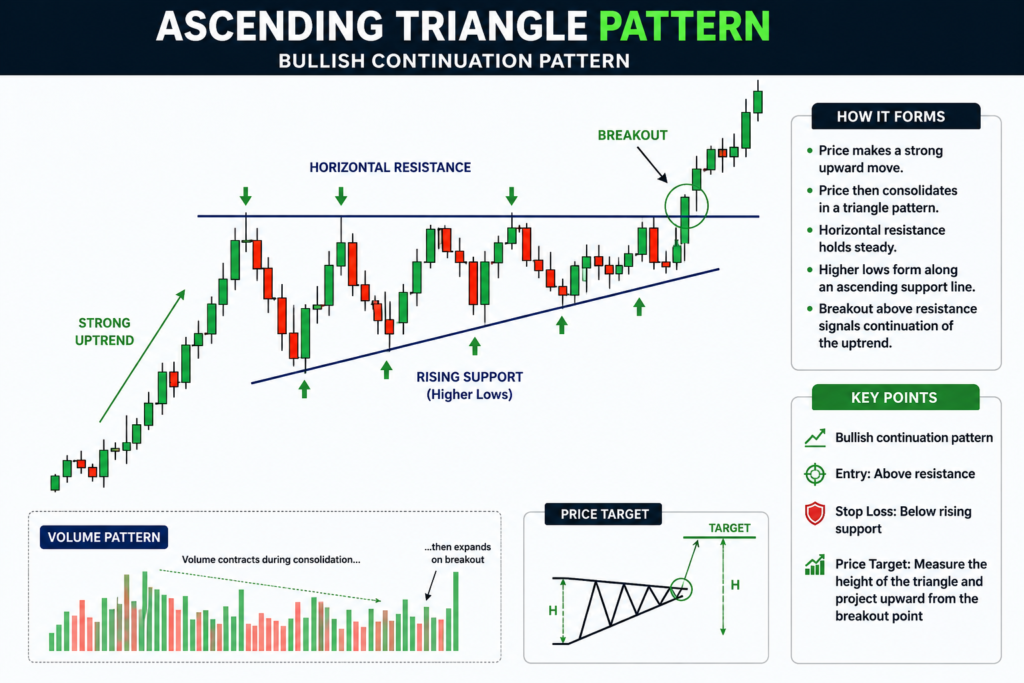
SHOWN BELOW are very common Candlestick patterns such as Double Top/Bottom, Rising/Falling Wedges, Bullish/Bearish Pennants, Triangles, and Horizontal patterns. For options traders, understanding candlestick patterns serves to improve market timing, enhance entry and exit decisions, and provide valuable insight into the ongoing battle between buyers and sellers.
TRADING NOTE: Candlestick patterns can form on all time frames. Depending on the time frame you are trading, it is a good idea to look for candlestick patterns on a higher and lower timeframe. For Example, if you are using a daily trading strategy, then in addition to looking at the patterns on the daily chart, look at the weekly and 4-hour charts. This will give you valuable insight.
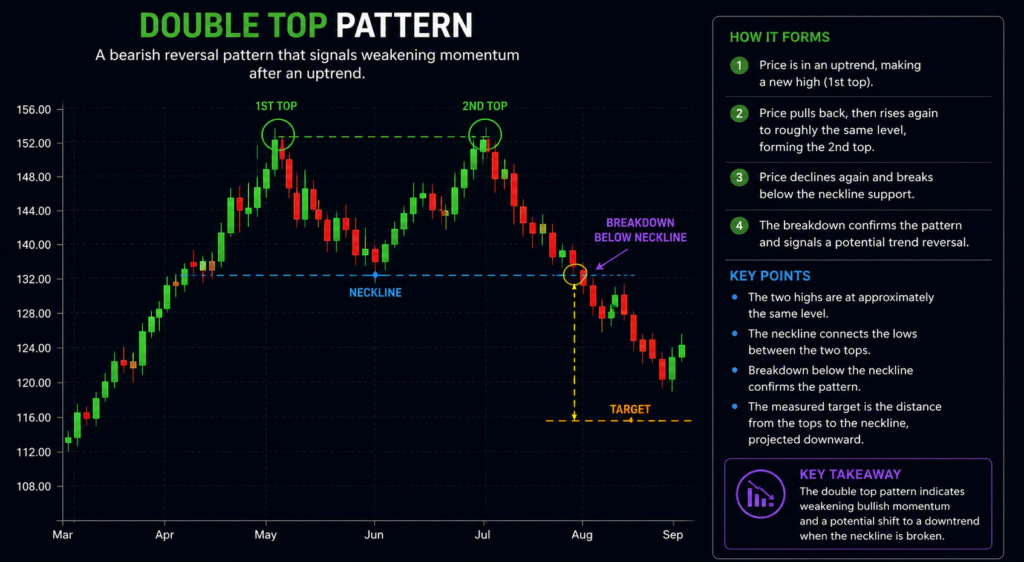
DOUBLE TOP / DOUBLE BOTTOM are among the most recognized reversal patterns in technical analysis and can provide valuable clues about potential changes in market direction.
A Double Top forms after an uptrend when price tests a resistance level twice but fails to break higher, suggesting that buying momentum may be weakening and a bearish reversal could be developing. Conversely, a Double Bottom forms after a downtrend when price tests a support level twice and fails to move lower, indicating that selling pressure may be diminishing and a bullish reversal is forming.
Avoid acting solely on the pattern itself and instead look for confirmation through a break of the neckline, increased volume, supporting technical indicators, and overall market conditions.
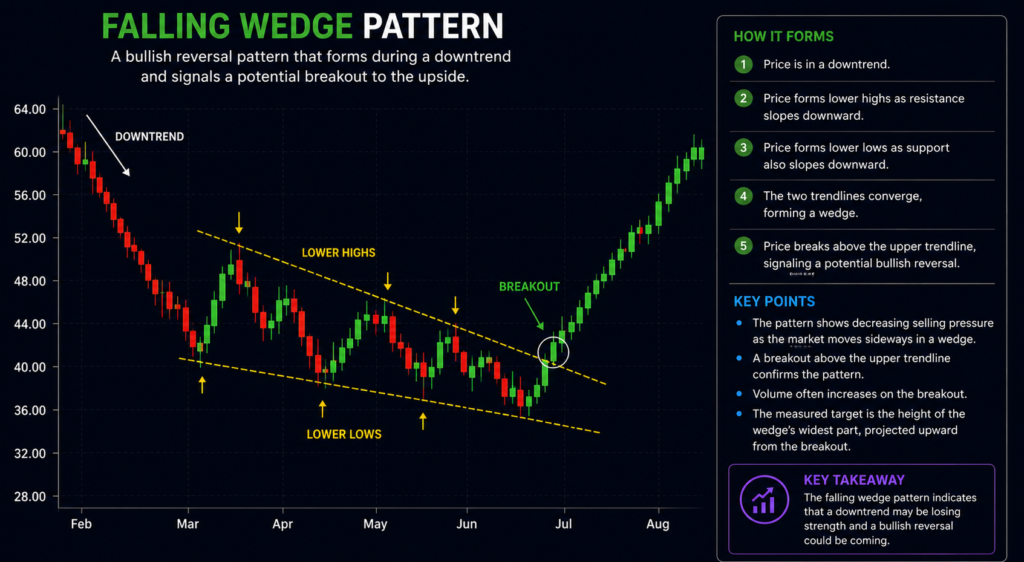
RISING AND FALLING WEDGE patterns are important technical formations that can signal potential changes in trend direction or the continuation of an existing trend. A Rising Wedge develops when price moves higher within two converging upward-sloping trendlines, often indicating that bullish momentum is weakening. When price breaks below the lower trend-line, it may signal a bearish reversal or the continuation of a downward move.
In contrast, a Falling Wedge forms when price moves lower within two converging downward-sloping trendlines, suggesting that selling pressure is gradually diminishing. A breakout above the upper trendline can indicate a bullish reversal or the continuation of an existing uptrend.
Traders should seek confirmation through increased volume, supporting technical indicators, and overall market context before entering a trade. When combined with trend analysis, support and resistance levels, wedge patterns provide valuable insight into potential breakout opportunities and shifts in market momentum.
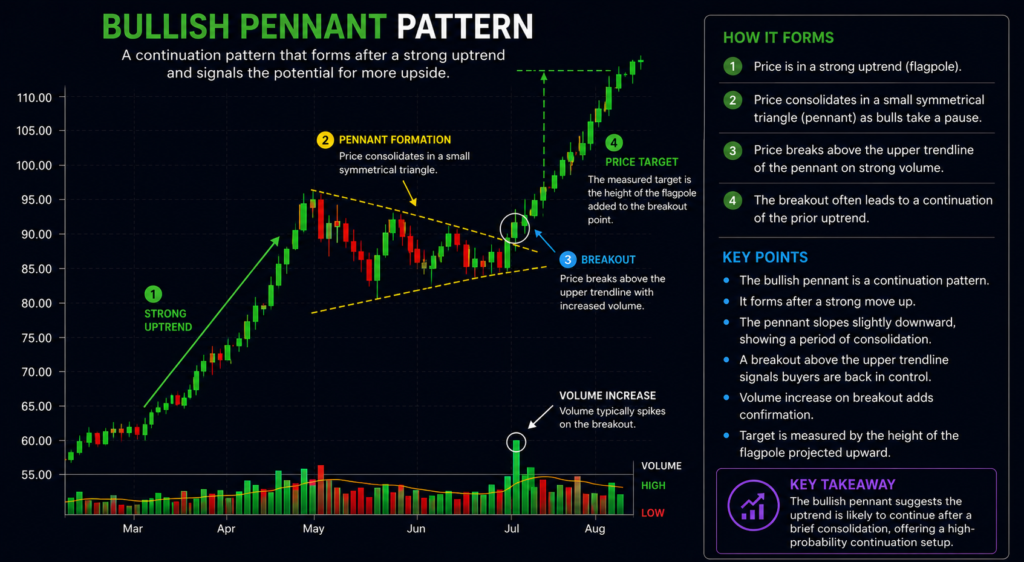
PENNANT patterns are a continuation pattern that forms after a strong and rapid price movement, known as the flagpole, followed by a brief period of consolidation where price moves within converging trend-lines that resemble a small symmetrical triangle. This pause in price action represents a temporary balance between buyers and sellers before the prevailing trend resumes.
In a Bullish Pennant, the pattern develops after a strong upward move and signals the potential for continued gains when price breaks above the upper trendline. In a Bearish Pennant, the pattern forms after a sharp decline and may indicate further downside when price breaks below the lower trendline.
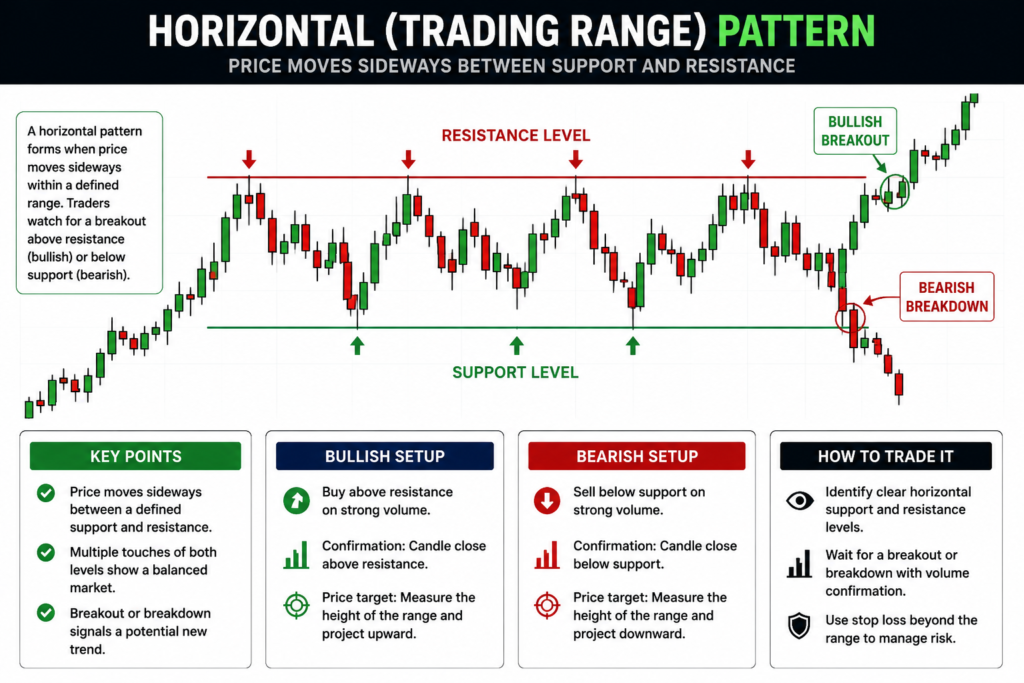
HORIZONTAL candlestick patterns represents a period of market consolidation where price trades within a defined range between support and resistance levels. This pattern reflects a temporary balance between buyers and sellers, with neither side gaining sufficient control to establish a new trend. Traders often view horizontal trading ranges as periods of accumulation or distribution and closely monitor them for breakout opportunities. A decisive move above resistance may signal bullish momentum, while a breakdown below support can indicate bearish sentiment.
TRADING NOTE: Keep in mind that price may breakout in either direction at any time. As noted previously, like any candlestick patterns, horizontal patterns can form on all time frames.
ASCENDING TRIANGLES is a bullish chart pattern characterized by a horizontal resistance level and a rising support trendline formed by a series of higher lows. This pattern reflects increasing buying pressure as buyers steadily bid prices higher while sellers continue defending a specific resistance area. As the range narrows, the probability of a breakout increases. A successful breakout above resistance, particularly when accompanied by strong trading volume, is often interpreted as a signal that bullish momentum is gaining strength. Descending Triangle in the inverse of the Ascending.